


Featured18 Sept 2026
Traffic But No Enquiries
12 reasons visitors arrive but leave without becoming leads

Hitesh Mistry
18 Sept 2026 • 28 min read
Ahmedabad has a strong manufacturing and industrial ecosystem covering engineering, chemicals, pharmaceuticals, textiles, machinery, packaging, plastics, food processing, construction materials and many other sectors.
Many manufacturers have invested heavily in factories, machinery, production capacity, certifications, quality control and distribution networks.
But their websites often receive much less attention.
A typical manufacturing website may contain a homepage, a short company profile, a basic product list, infrastructure photographs and a contact page.
Technically, the company has a website.
Commercially, however, that website may be doing very little to generate qualified enquiries.
Modern B2B buyers frequently research suppliers online before initiating a conversation. They may search for a specific product, application, material, manufacturing capability or supplier location.
If your website cannot clearly communicate what you manufacture, where your products are used, what capabilities you have and how a buyer can enquire, potential opportunities can move to competitors.
This guide explains how manufacturers in Ahmedabad can structure their websites around B2B lead generation rather than simply online presence.

Traditional manufacturing websites were often created primarily to establish credibility.
The structure usually looked something like this:
Home → About Us → Products → Infrastructure → Contact Us
That structure can still contain useful information, but it may not align with how modern B2B buyers research suppliers.
A prospective buyer might arrive through Google after searching for:
Your website therefore needs to answer more than "Who are we?"
It should help answer:
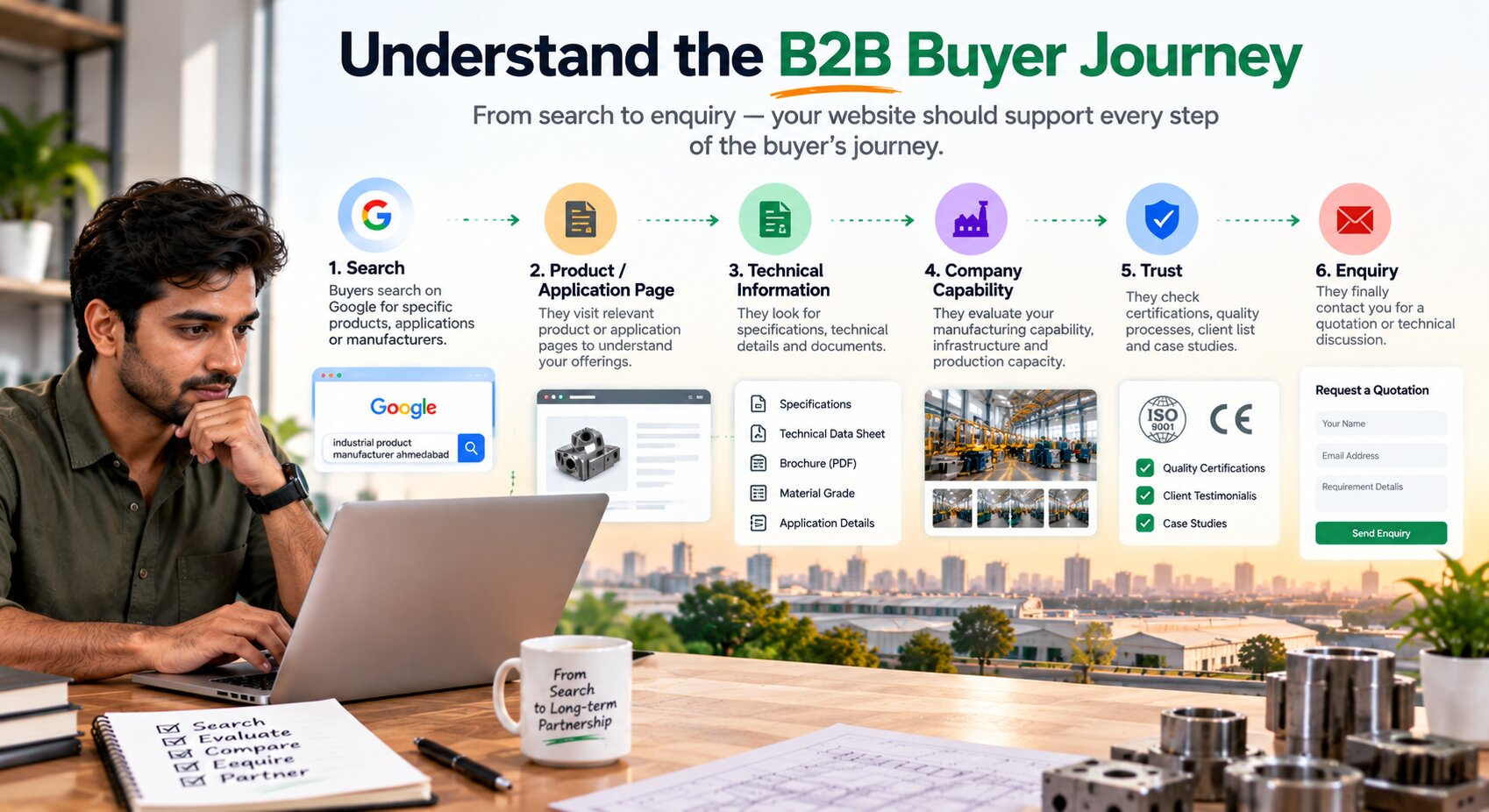
Before redesigning a manufacturing website, understand how potential customers discover and evaluate suppliers.
A simplified journey might look like this:
Google Search → Product/Application Page → Technical Information → Company Capability → Trust → Enquiry
Another buyer may follow:
Referral → Company Website → Product Range → Infrastructure → Certification → Contact
An international buyer might follow:
Google Search → Manufacturer Page → Product Specification → Export Capability → Enquiry
Your website should support multiple buyer journeys rather than forcing every visitor through the homepage.
One of the most common problems on manufacturing websites is putting the entire product catalog on one page.
For example:
Products
Each product may have only an image and one paragraph.
This makes it harder for search engines to understand individual products and gives buyers limited information.
Important products should generally have dedicated pages when there is enough meaningful information to justify them.
Depending on your industry, a useful product page can include:
The exact information will depend on your product and what can appropriately be published online.
Instead of:
/products/
your website might contain:
This gives each important product a focused destination for users, SEO, advertising and internal linking.
B2B buyers do not always search by your exact product terminology.
Sometimes they search according to the problem they are solving or the application where the material is used.
This creates an important SEO opportunity.
For example, imagine a manufacturer sells one industrial material used across:
A generic product page may not explain each use case in enough detail.
Application-specific content can explain how the product relates to that use case and link visitors back to the appropriate product.
A useful SEO architecture can look like:
Product → Grade → Application → Industry → Buyer Search
For example:
Industrial Material → Specific Grade → Textile Application → Textile Industry → Relevant Search Query
This creates substantially more search context than simply listing a product name.
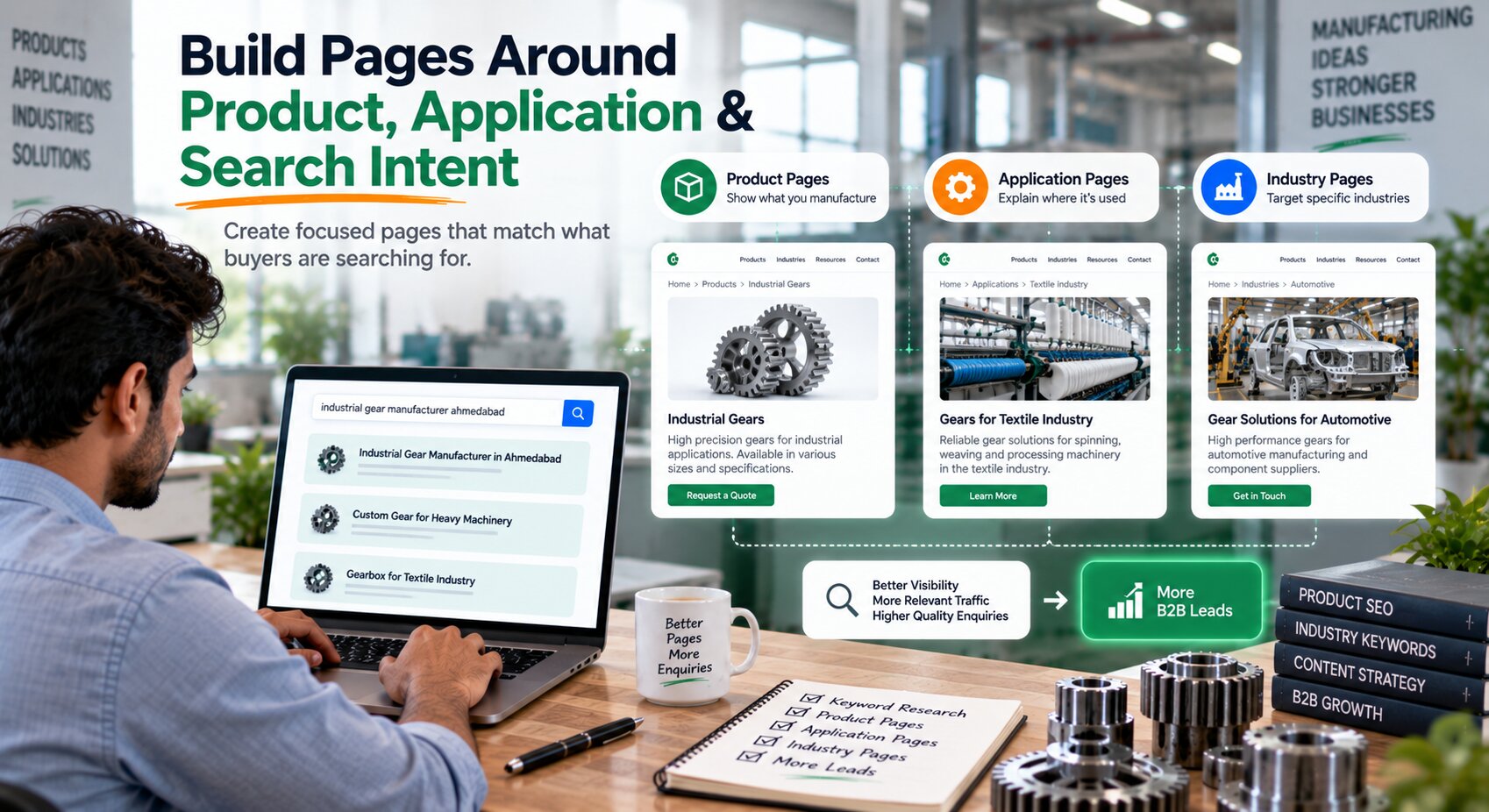
If the same manufacturing company serves several industries, consider creating dedicated industry pages where there is enough unique information.
For example:
Each page can explain:
This allows buyers to see your company in the context of their industry rather than trying to interpret a generic product catalog.
I help manufacturers improve website structure, product presentation, UI/UX, technical SEO and lead generation journeys.
Manufacturing SEO should not focus only on high-volume keywords.
Lower-volume searches can sometimes have stronger commercial intent.
Consider the difference between:
"What is Product X?"
and:
"Product X manufacturer in Ahmedabad"
The first may indicate informational research.
The second suggests someone may be actively looking for a supplier.
These are keyword patterns rather than recommendations to create repetitive pages for every location or phrase.
Pages should exist because they provide genuinely useful information to the buyer.
B2B buyers often need more technical information than consumers.
Depending on the product, buyers may want:
If this information is available and appropriate to publish, make it easy to locate.
A buyer should not need to download a 40-page corporate brochure simply to discover a basic product specification.
Manufacturing websites often contain useful PDFs such as:
These can support buyers who need detailed technical information.
However, PDFs should complement useful HTML product content rather than replace it completely.
A product page can provide the essential information and then offer the relevant technical document for users who need additional detail.
One of the advantages manufacturers have over generic traders or resellers is their actual production capability.
Show it.
Depending on what can be publicly disclosed, your website can present:
Real photography is often more persuasive than generic industrial stock imagery.
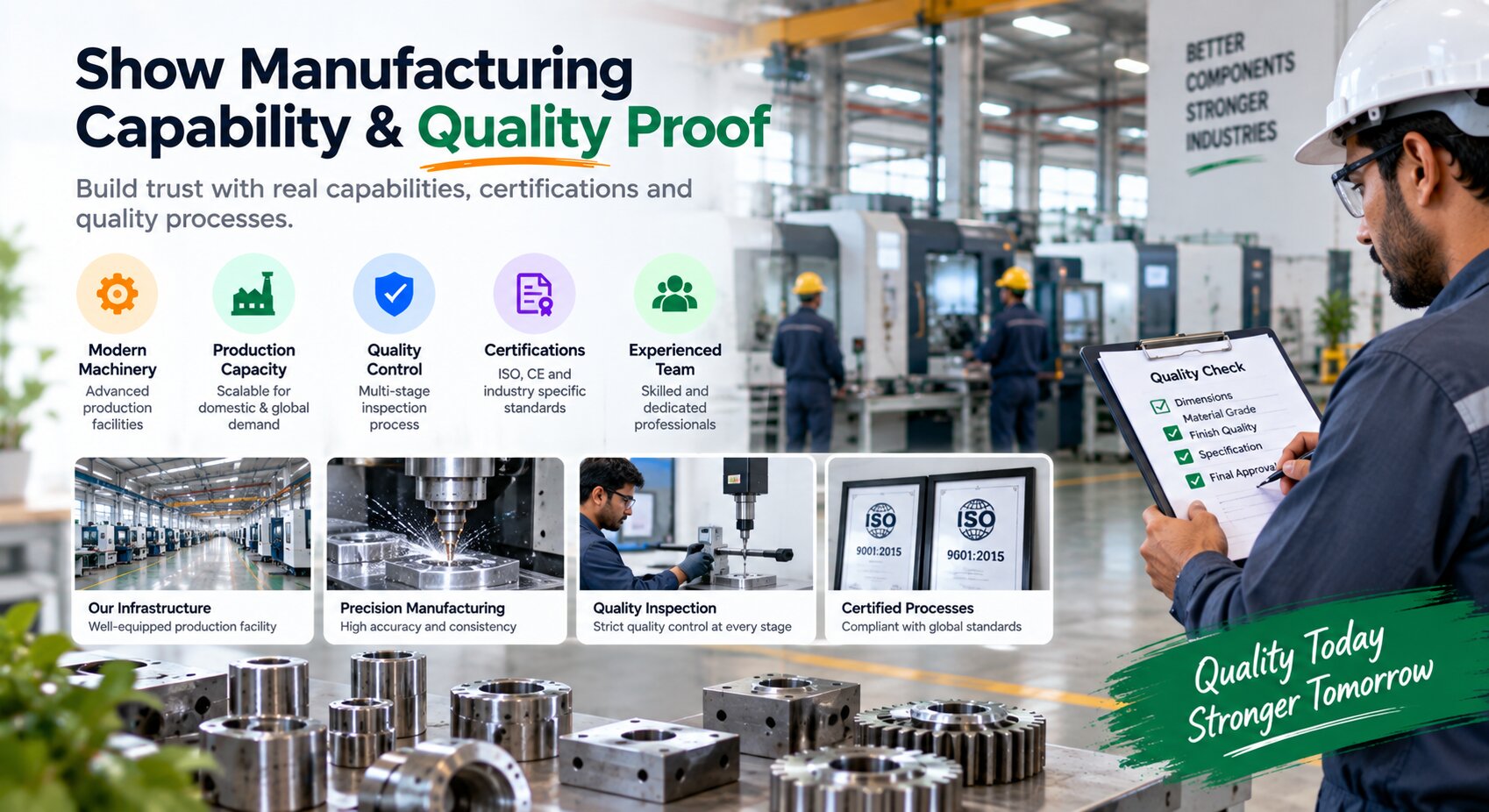
Certifications can be important trust signals for industrial buyers.
Depending on your industry, these might relate to:
Only display certifications your company genuinely holds and keep their information current.
Where appropriate, explain what the certification relates to instead of displaying a row of unexplained logos.
Location information can help buyers understand whether your company can serve them.
If you supply across India, explain your distribution coverage.
If you export, provide relevant information about export markets and capabilities where appropriate.
Potential international buyers may want to understand:
Avoid vague claims such as "global leader" unless you have meaningful evidence to support them.
A generic contact form containing only:
may not capture enough context for a B2B manufacturing enquiry.
A product enquiry form could potentially ask for:
But avoid making every field mandatory unless it is genuinely needed.
Long forms can create unnecessary friction.
If someone submits an enquiry directly from a product page, your system should ideally capture which product they were viewing.
Instead of receiving:
"I need more information."
your sales team can receive:
"Enquiry received from Product X page."
This reduces ambiguity and helps sales teams respond with more context.
Manufacturing websites sometimes hide the Contact Us link in the header and assume interested buyers will find it.
Instead, add context-specific CTAs throughout important pages.
Examples include:
The appropriate CTA depends on the buyer journey and your internal sales process.
B2B buyers often want evidence that you can handle requirements similar to theirs.
Case studies can explain:
If customer confidentiality prevents you from naming the organization, you may still be able to create anonymized application stories where appropriate.
Case studies should use factual, verifiable outcomes rather than unsupported marketing claims.
Not every potential customer is ready to request a quotation during their first visit.
Some are researching.
Some are comparing materials.
Some are identifying possible suppliers.
Useful manufacturing content can include:
This creates a broader organic search footprint while demonstrating expertise.
A common SEO mistake is publishing articles that exist independently from the rest of the website.
Your content should support the commercial architecture.
For example:
Technical Blog → Application Page → Product Page → Enquiry
or:
Industry Guide → Industry Page → Relevant Products → Request Quote
Internal links help both users and search engines understand the relationship between your content.
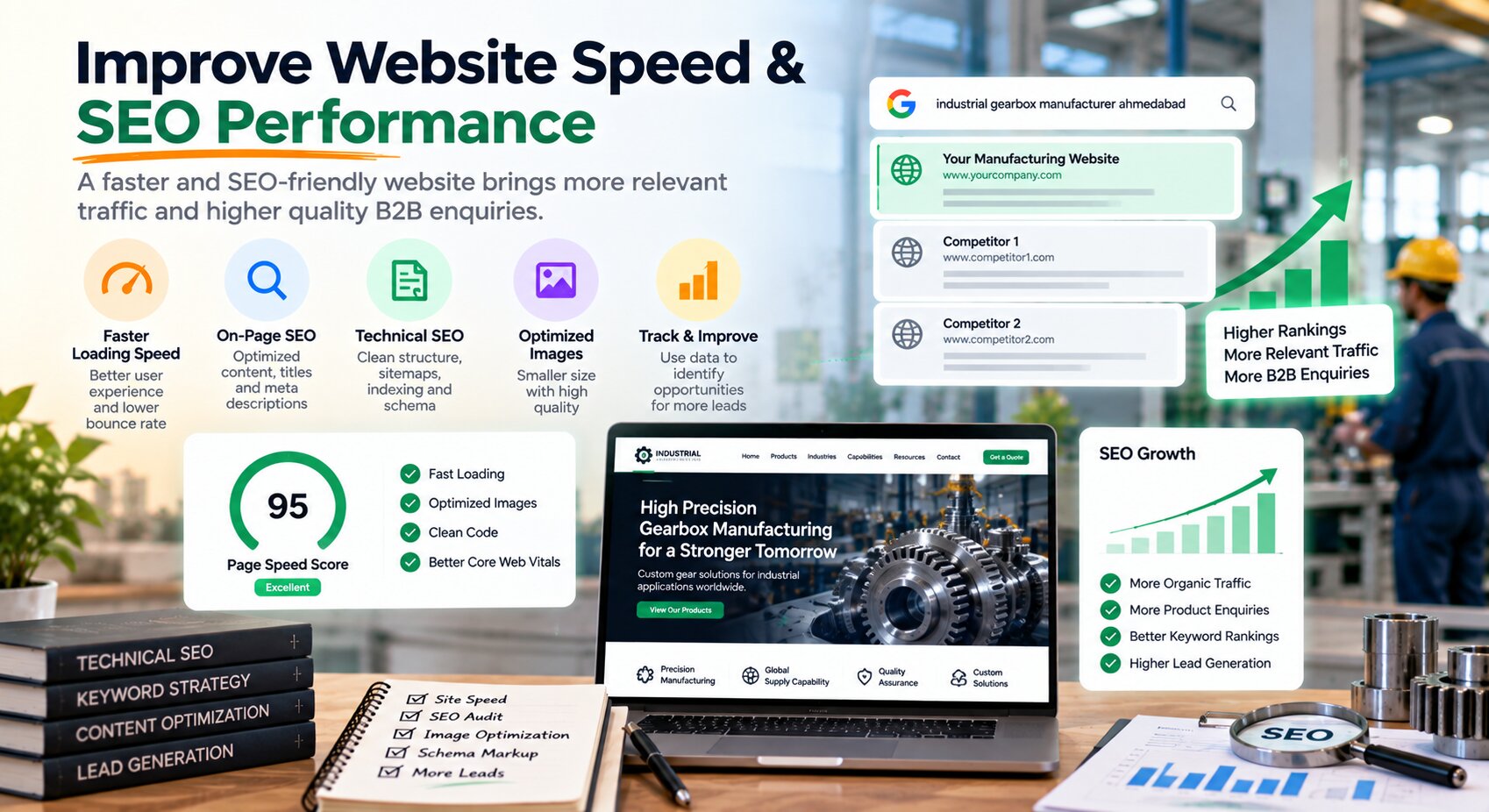
Manufacturing websites frequently contain large photographs, catalogs, sliders and videos.
Without optimization, these assets can make pages unnecessarily heavy.
Review:
If your manufacturing website runs on WordPress, see my WordPress Speed Optimization Guide.
Do not assume B2B research happens only on desktop computers.
Decision-makers, distributors, procurement teams and business owners may visit your website from phones throughout the research process.
Check:
A technical specification table that works beautifully on desktop can become unusable if it overflows incorrectly on mobile.
Good content still needs a technically accessible website.
Manufacturing websites should review:
My Technical SEO Checklist provides a more detailed technical review.
Structured data can help search engines better understand certain information on your website.
Depending on the page and content, relevant schema types may include:
Schema should accurately represent visible page content rather than being added simply to include more markup.
If your website generates enquiries but you don't know which pages or channels produced them, it becomes difficult to improve marketing intelligently.
Consider tracking:
Combine this with traffic-source and landing-page information to understand which parts of the website contribute to lead generation.
More enquiries are not always better if most enquiries are irrelevant.
A manufacturer may receive:
Marketing performance should therefore consider qualified B2B opportunities rather than simply counting every form submission as an equal lead.
Generating an enquiry is only the beginning.
If leads sit unnoticed in an email inbox for several days, the website cannot solve the entire sales problem.
A more structured workflow might look like:
Website Enquiry → Notification → Lead Assignment → Sales Follow-Up → Qualification → Quotation → Follow-Up
Depending on the organization, this can be managed manually or connected to a CRM or internal lead management system.
Automation should solve an actual operational problem rather than being added for novelty.
Useful examples can include:
This is where a manufacturing website can begin connecting marketing with internal sales operations.
If your company runs Google Ads, LinkedIn campaigns, exhibitions, email outreach or other campaigns, don't automatically send every visitor to the homepage.
A dedicated landing page can align directly with the campaign.
For example:
Campaign for Product A → Product A Landing Page → Specifications → Manufacturing Capability → Enquiry
This creates a more focused journey than sending the user to a generic homepage.
Manufacturers often participate in exhibitions and trade shows.
Your website can support these offline activities.
For example:
This allows offline marketing to connect with measurable digital activity.
Some manufacturing websites contain almost no useful HTML content because all product information exists inside downloadable catalogs.
This creates several usability and SEO limitations.
Important product and application information should ideally exist directly on relevant website pages, with PDFs available as supplementary resources.
A B2B manufacturing website might use an architecture such as:
The exact architecture should reflect your actual products, customers and search demand rather than following a template blindly.
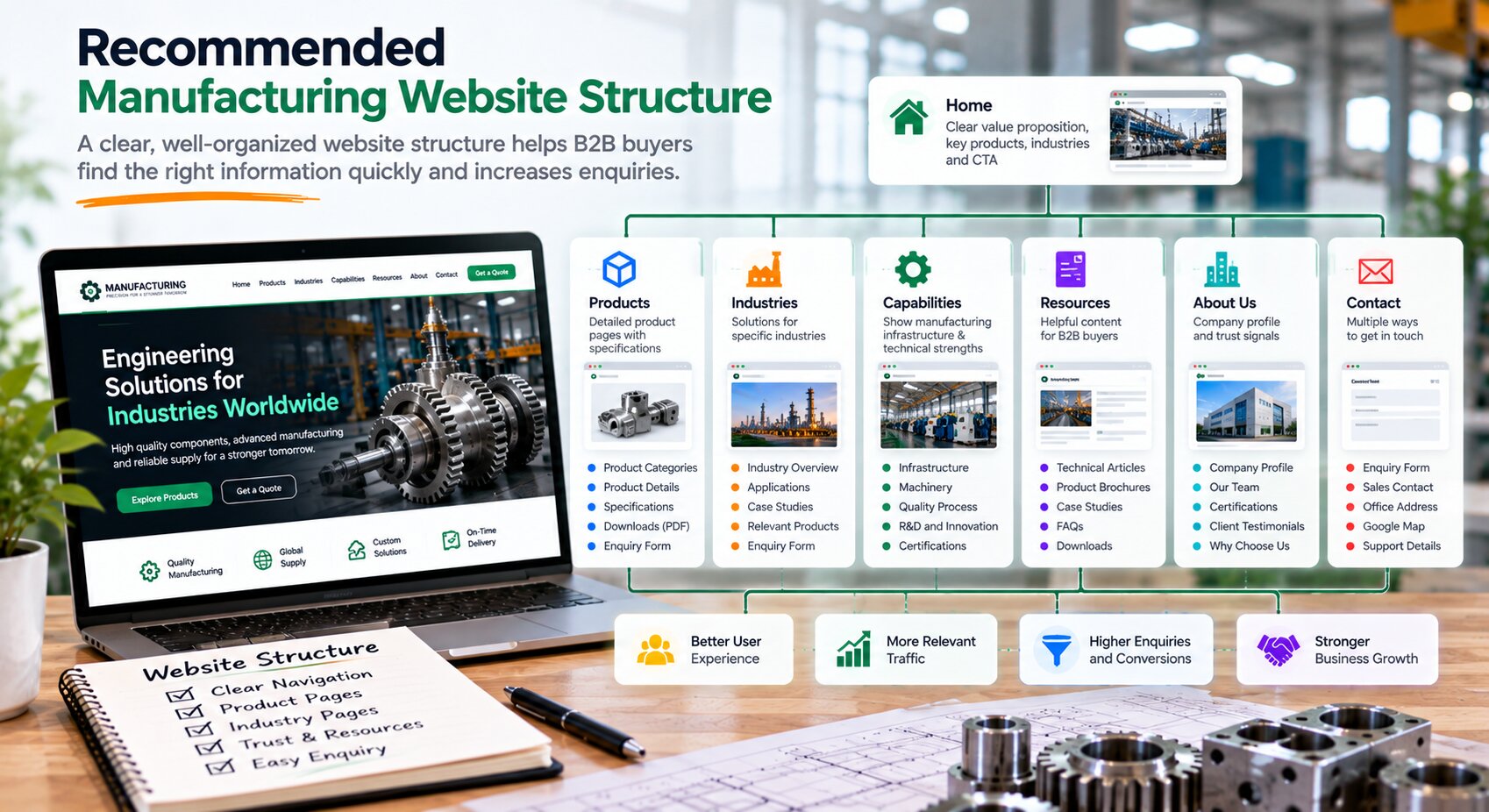
Imagine a manufacturer supplies an industrial product used by pharmaceutical companies.
A potential buyer searches:
"[product] manufacturer in Gujarat"
They discover your product page.
The page contains:
The buyer submits an enquiry.
The website automatically captures the product page and source.
Your sales team receives:
Product + Company + Contact + Quantity + Requirement + Source
That is a much more useful digital sales journey than simply displaying a corporate brochure online.
| Area | What to Check |
|---|---|
| Products | Dedicated pages for important products |
| Applications | Content explaining where products are used |
| Industries | Industry-specific information where relevant |
| Technical Data | Specifications and useful downloadable resources |
| Trust | Facility, certifications, quality and relevant proof |
| SEO | Product, application and commercial search intent |
| Conversion | Clear product-specific enquiry journeys |
| Analytics | Track meaningful lead actions and sources |
| Sales | Defined process after an enquiry arrives |
A redesign may be worth considering when:
Use my Website Redesign Checklist before rebuilding an existing site so that valuable URLs, content and SEO signals are considered during migration.
Traffic alone does not prove the website is reaching potential buyers.
Review:
Read Why Your Website Gets Traffic But No Enquiries for a detailed conversion diagnosis.
Technical development skills are important, but manufacturing websites also require understanding of information architecture, search intent and B2B buying behaviour.
A development partner should be able to discuss questions such as:
If you're evaluating development partners, read How to Choose a Website Developer in Ahmedabad.
Yes. A manufacturing website can support B2B lead generation when relevant buyers can discover useful product or application content, evaluate the company's capabilities and easily submit an appropriate enquiry.
Start by researching how potential buyers search for your products, applications and supplier capabilities. Build useful pages around those needs, implement technical SEO, strengthen internal linking and provide clear conversion paths.
Important products generally benefit from dedicated pages when there is enough unique information to create useful content. Very similar variants may sometimes be better grouped rather than creating thin, repetitive pages.
A blog or resource section can be valuable when the company has useful expertise to share around applications, product selection, materials, technical questions or industry problems. Publishing generic content simply to increase article count is less useful.
It depends on the sales model. Many B2B products have pricing that varies by quantity, grade, specification, packaging, logistics or commercial terms. In those cases, a quotation-based approach may be more appropriate.
Location-based keywords can be useful when supplier location is relevant to buyers. However, manufacturers serving national or international markets should also build content around products, applications, industries and broader geographic intent rather than focusing only on Ahmedabad.
There is no fixed timeline. Results depend on competition, current website authority, technical condition, content quality, search demand and off-page signals. SEO should be evaluated over time using visibility, qualified traffic and lead quality rather than expecting immediate rankings.
Yes. Depending on the website and CRM setup, enquiries can be routed based on product, region, business unit or other form data.
There is no single page that is most important for every manufacturer. For search-driven B2B websites, individual product and application pages can be particularly important because they often match specific buyer intent.
A manufacturing website should do more than establish that your company exists.
It should help potential buyers discover your products, understand applications, evaluate technical capabilities, verify credibility and move naturally toward an enquiry.
For Ahmedabad manufacturers, the opportunity is to connect website development, SEO, product information, B2B user experience and sales processes into one digital system.
Start with the fundamentals:
Product Pages → Application Content → Industry Context → Technical Information → Trust → Enquiry → Sales Follow-Up
Once this foundation is in place, SEO, content marketing, paid campaigns and automation can work together much more effectively.
The objective is not simply more website traffic. It is to create a website that attracts relevant B2B buyers and gives qualified prospects enough information and confidence to start a business conversation.
Share this article:


UI/UX Designer, Full-Stack Developer and Digital Experience Consultant with over 10 years of professional experience in helping businesses succeed online.
12 reasons visitors arrive but leave without becoming leads

A practical guide to finding the right development partner for your business

What to review before, during and after redesigning your website

A practical 2026 pricing guide for businesses
— LET'S BUILD SOMETHING
Let's review your products, applications, target industries, current website and sales journey to identify how design, development, SEO and automation can support qualified B2B enquiries.
