


Featured18 Sept 2026
Website Redesign Checklist
What to review before, during and after redesigning your website

Hitesh Mistry
18 Sept 2026 • 14 min read
Your website is receiving traffic. Google Analytics shows visitors arriving. Search Console reports impressions and clicks. Maybe you're also running social media or paid campaigns.
But there is one problem:
The enquiries aren't coming.
This situation often leads businesses to conclude that they simply need more traffic.
Sometimes that's true. But frequently, traffic volume isn't the main problem.
The problem is what happens after someone reaches the website.
Your website needs to help visitors understand your offer, determine whether it is relevant to them, trust your business and confidently take the next step.
If one of those stages breaks, traffic may increase without producing meaningful business results.
Let's look at 12 common reasons why a website gets traffic but doesn't generate enough enquiries.
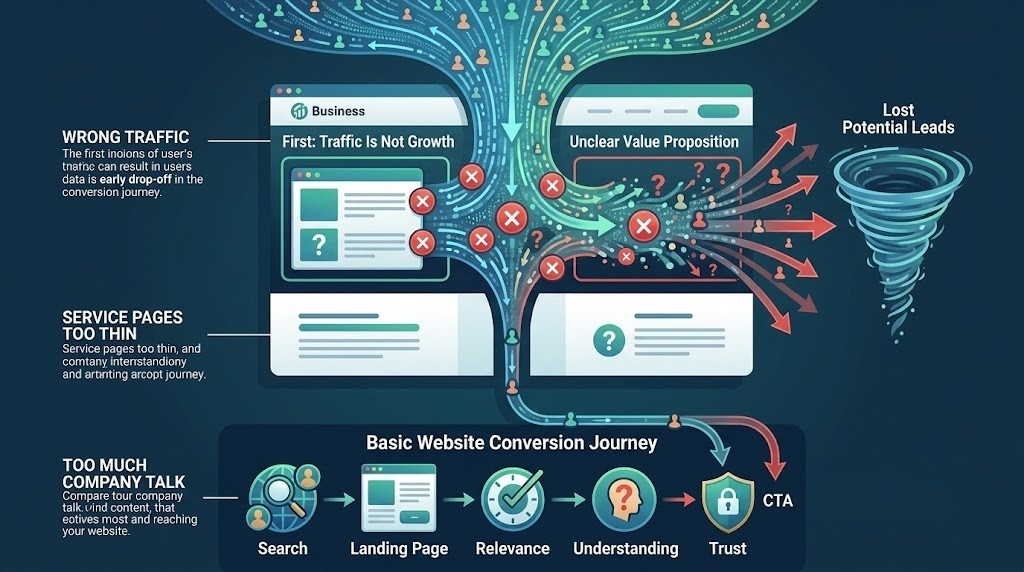
Website traffic is useful, but the number of visitors alone doesn't tell you whether your website is helping the business.
Consider these two examples:
Website A: 5,000 monthly visitors and 5 qualified enquiries.
Website B: 800 monthly visitors and 25 qualified enquiries.
Website A has substantially more traffic, but Website B may be creating more business opportunities.
The objective is not simply to attract visitors. It is to attract the right visitors and give them a convincing path toward the appropriate action.
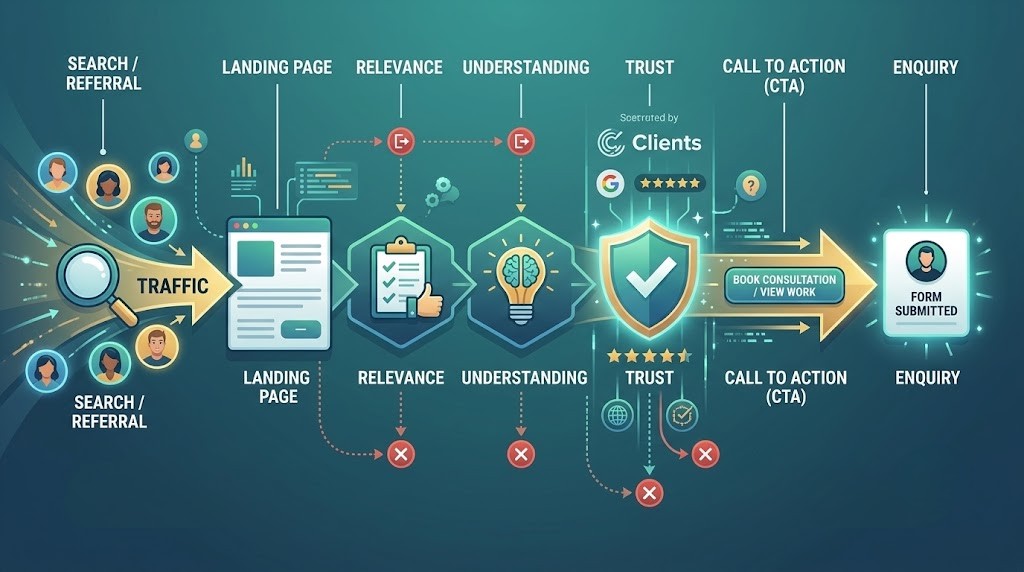
A simplified lead-generation journey looks like this:
Search / Referral → Landing Page → Relevance → Understanding → Trust → CTA → Enquiry
If a visitor loses confidence at any stage, the journey stops.
Before redesigning buttons or changing form colours, check whether your visitors are actually potential customers.
A website can attract substantial informational traffic that has little commercial value.
For example, a web development company could rank for a generic coding tutorial. That traffic may be useful for authority, but many visitors are developers looking for an answer rather than businesses looking to hire a developer.
Compare that with someone searching:
Those searches indicate a very different level of commercial intent.
A visitor should not need to read five sections before understanding what your business does.
Your key pages should clearly communicate:
A vague headline such as "Transforming Possibilities Into Excellence" may sound impressive but doesn't necessarily tell a new visitor what the company actually provides.
Clarity usually matters more than clever wording.
Many business websites begin with:
That information can be useful, but customers initially arrive with their own questions.
They want to know:
Your content should balance information about the company with information that helps customers make a decision.
A common website structure is a single Services page containing several cards with one sentence each.
That may not provide enough information for either potential customers or search engines to understand the service in depth.
An important service page can explain:
Dedicated service pages also give your blog content more relevant commercial pages to link to.
I can help identify where your website journey is losing potential customers and what should be improved.
Don't assume visitors will automatically search for your Contact page when they become interested.
Every major page should have an appropriate next step.
Depending on the context, that could be:
The CTA should also match the visitor's stage.
Someone reading an educational blog may respond better to "Discuss your website" than an aggressive "Buy now" message.
Imagine a visitor has finally decided to contact you and then encounters a form asking for:
Some projects genuinely require detailed qualification, but every additional mandatory field introduces friction.
Ask yourself what information is essential before the first conversation and what can be collected later.
A visitor may understand your service and still hesitate because there is not enough evidence to trust the business.
Useful trust signals include:
For service businesses, case studies can be particularly effective because they show how you approach actual problems rather than simply claiming expertise.
See examples in my case study portfolio.
A website can look excellent on a large monitor but become difficult to use on a phone.
Common problems include:
Test the complete enquiry journey on a real mobile device, not only through a desktop browser's responsive preview.
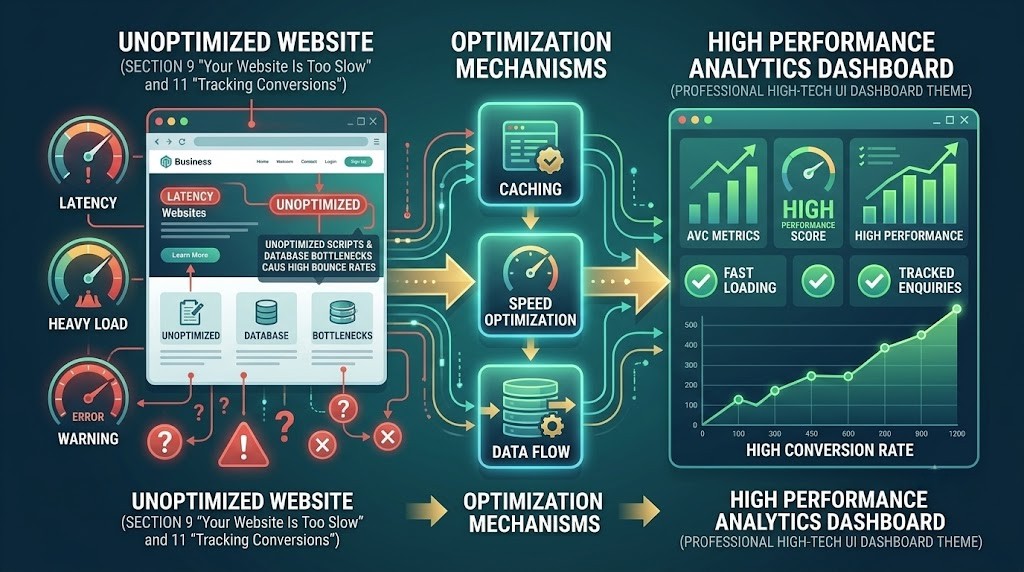
Visitors have little reason to wait for a slow page when alternatives are readily available.
Performance issues can come from:
If you use WordPress, my WordPress Speed Optimization Guide provides a more detailed troubleshooting process.
Potential customers often need practical information before contacting a business.
Depending on your service, they may want to know:
If the website doesn't answer any of these questions, the visitor may continue researching somewhere else.
This is why commercially focused educational content can be useful. For example, my Website Development Cost in Ahmedabad guide helps potential clients understand budget factors before contacting me.
Sometimes the website is generating activity but the business doesn't have enough data to understand it.
Consider tracking meaningful actions such as:
Without conversion tracking, it becomes difficult to know which pages and marketing channels contribute to enquiries.
After someone reads a service page, case study or blog article, what happens?
If the answer is "nothing," you are leaving the journey incomplete.
Each content type should connect naturally to another stage.
For example:
Blog → Relevant Service → Case Study → Contact
or:
Google Search → Service Page → Proof → Consultation
Internal linking therefore has both SEO and conversion value.
Find the pages where potential customers first enter the website.
Determine what visitors were likely trying to accomplish when they reached each page.
Can a new visitor quickly understand the offer and next step?
Does the page provide enough evidence for visitors to trust your claims?
Is it visible, relevant and functional?
Submit an enquiry yourself on desktop and mobile and confirm that the message actually reaches the intended inbox or CRM.
Compare traffic sources, landing pages and conversion activity rather than looking only at total sessions.
Often the answer is both, but the order matters.
If your website already receives relevant visitors but doesn't convert them, sending substantially more traffic into the same weak journey may simply increase the number of people who leave.
Fix major conversion problems while continuing to improve qualified traffic acquisition.
Not every conversion problem requires a full redesign.
Sometimes improving messaging, forms, CTAs or service pages is enough.
A redesign becomes more appropriate when the problems are structural, such as:
If that sounds familiar, use my Website Redesign Checklist for Small Businesses before rebuilding the website.
Common causes include irrelevant traffic, unclear messaging, weak service pages, insufficient trust, poor mobile UX, slow performance, weak CTAs and complicated enquiry forms.
Start by identifying which visitors you want to convert, then improve landing-page relevance, messaging, trust signals, calls to action and the enquiry process. Measure changes using conversion tracking.
Not necessarily. Traffic needs to be relevant, and the website must successfully move suitable visitors toward an enquiry or purchase.
There is no universal rate that applies to every website. Conversion rates vary significantly by industry, traffic source, offer, intent and what the website defines as a conversion. Your own qualified conversion trend is generally more useful than chasing a generic benchmark.
Not automatically. First diagnose whether the problem comes from traffic quality, messaging, content, trust, UX, forms or technical issues. Redesign when the underlying problem is structural enough to justify it.
Yes, particularly when content targets relevant search intent and connects informational visitors to appropriate commercial pages. However, traffic alone does not guarantee enquiries.
If your website receives traffic but generates very few enquiries, don't immediately assume you need thousands of additional visitors.
First examine the journey those visitors experience.
Are they the right audience? Can they understand what you offer? Do they trust you? Can they easily take the next step?
Improving those areas can turn your website from a passive online presence into a more effective part of your lead-generation process.
Share this article:


UI/UX Designer, Full-Stack Developer and Digital Experience Consultant with over 10 years of professional experience in helping businesses succeed online.
What to review before, during and after redesigning your website

A practical 2026 pricing guide for businesses

Turn your manufacturing website from a digital brochure into a structured B2B lead generation channel
— LET'S BUILD SOMETHING
Let's review your website's messaging, UX, trust signals, service pages and enquiry journey to identify practical opportunities for improvement.
