


Featured18 Sept 2026
Website Development Cost
A practical 2026 pricing guide for businesses

Hitesh Mistry
18 Sept 2026 • 14 min read
When planning a new website, businesses frequently encounter the same question: should we build our website with WordPress or choose custom development?
There is no universally correct answer.
WordPress can be an excellent choice for one business and the wrong architecture for another. The same applies to custom development.
The decision should depend on what your website needs to achieve, how much customization is required, who will manage it, what integrations are needed and how the platform is expected to evolve.
This guide compares WordPress and custom website development from a practical business perspective, particularly for small and medium businesses evaluating website development in Ahmedabad.
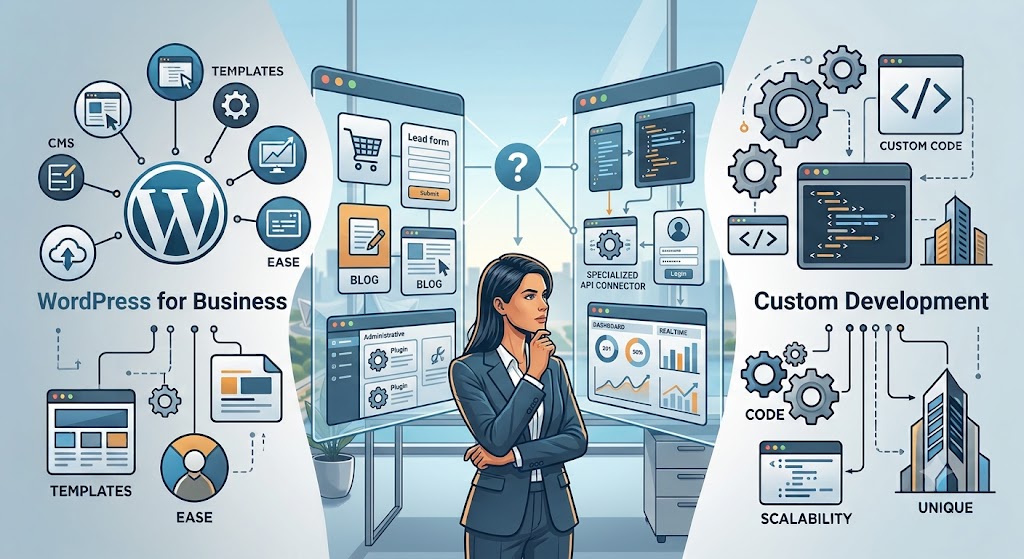
WordPress is a content management system that provides an established foundation for managing pages, posts, media, users and other website content.
Its ecosystem includes themes and plugins that can extend functionality without requiring every feature to be developed from scratch.
A WordPress website does not necessarily mean a ready-made template.
WordPress can be used with:
Therefore, two WordPress websites can differ dramatically in quality, performance and development complexity.
A custom website is developed around a specific set of requirements rather than relying primarily on a pre-existing CMS theme and plugin ecosystem.
Depending on the project, this might involve technologies such as React, Next.js, Node.js or another application stack.
Custom development can provide much greater control over architecture and functionality, but that flexibility also introduces additional development and maintenance responsibility.
| Factor | WordPress | Custom Development |
|---|---|---|
| Initial Development | Usually faster for standard requirements | Usually requires more development effort |
| Initial Investment | Generally lower for conventional websites | Generally higher due to custom engineering |
| Content Management | Built-in and user-friendly | Needs a CMS or custom admin solution |
| Customization | High, within WordPress architecture | Very high |
| Plugins / Extensions | Large ecosystem | Features usually integrated or developed specifically |
| Maintenance | Core, theme and plugin maintenance | Application and dependency maintenance |
| E-commerce | WooCommerce provides mature functionality | Can be built around specialized commerce requirements |
| Complex Workflows | Possible, but may eventually become plugin/custom-code heavy | Can be designed specifically for the workflow |
For conventional business requirements, WordPress generally allows development to start from an established CMS foundation, which can reduce the amount of functionality that needs to be built from scratch.
Custom development typically requires more engineering effort, particularly if an administrative interface, authentication, APIs or specialized workflows need to be created.
That does not mean WordPress is always inexpensive or custom development is always expensive.
A highly customized WordPress or WooCommerce project can exceed the cost of a relatively straightforward custom website.
If budget planning is your immediate concern, see my Website Development Cost in Ahmedabad guide.
WordPress can usually launch faster when your requirements closely match functionality already supported by the platform.
For example, pages, blogs, forms, user roles and standard e-commerce functionality already have mature solutions available.
Custom development usually requires additional planning and implementation because more of the application behaviour is being built specifically for the project.
However, using WordPress for a requirement that fundamentally does not fit WordPress can eventually make development slower rather than faster.
Both approaches can support custom UI/UX.
This is an important point because WordPress is sometimes incorrectly associated only with templates.
A custom WordPress theme can be designed around a unique visual system, while a custom-coded application can provide complete control over frontend architecture.
The bigger question is therefore not whether the design can be customized, but how efficiently the chosen platform can support the underlying functionality.
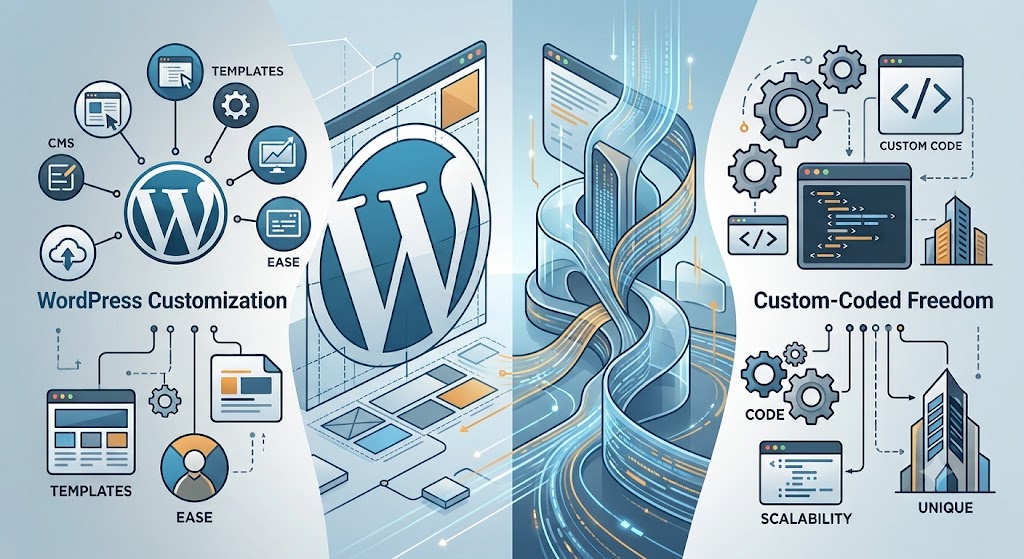
Content management is one of WordPress's strongest advantages.
Non-technical teams can manage:
A custom website can provide the same capability, but the CMS needs to be selected, integrated or developed as part of the architecture.
If your marketing team frequently updates website content, content management should be an important part of the technology decision.
WordPress has thousands of extensions for common requirements, but plugins should not automatically be installed for every problem.
A website built from too many overlapping plugins can become difficult to maintain and may introduce performance or compatibility issues.
Custom WordPress development can solve many specialized requirements without abandoning the platform entirely.
However, when the website behaves more like a software application than a content website, a custom architecture may become more appropriate.
Neither WordPress nor custom development is automatically fast.
A poorly developed custom website can be slow. A well-optimized WordPress website can perform very well.
WordPress performance depends on factors including:
You can read my WordPress Speed Optimization Guide for a deeper look at these factors.
I help businesses evaluate their requirements before choosing WordPress, custom development or another suitable technology.
Both WordPress and custom websites can be optimized for search engines.
WordPress provides convenient SEO management through its CMS and ecosystem, while custom development gives developers direct control over how metadata, schema, sitemaps, canonical URLs and rendering are implemented.
The platform alone does not determine whether a website will rank.
SEO also depends on:
Use my Technical SEO Checklist to understand the development side of SEO.
Security should be evaluated based on implementation and maintenance rather than assuming one platform is automatically secure and the other is not.
WordPress websites require regular updates, secure credentials, trusted plugins/themes, backups and appropriate server security.
Custom applications also require dependency updates, secure development practices, server maintenance and ongoing vulnerability management.
Every publicly accessible system requires maintenance.
WordPress maintenance commonly involves:
Custom websites require a different maintenance model involving application dependencies, hosting infrastructure, code changes and framework upgrades.
Neither approach should be treated as "build once and never maintain again."
WordPress can support substantial websites and e-commerce stores when the architecture, hosting and database are properly designed.
However, there is a point where highly specialized workflows, real-time features or application-level requirements may be better served by custom architecture.
Scalability should therefore be considered in terms of your expected business requirements rather than simply anticipated visitor numbers.
WordPress can be a strong option when you need:
Custom development becomes more relevant when you require:
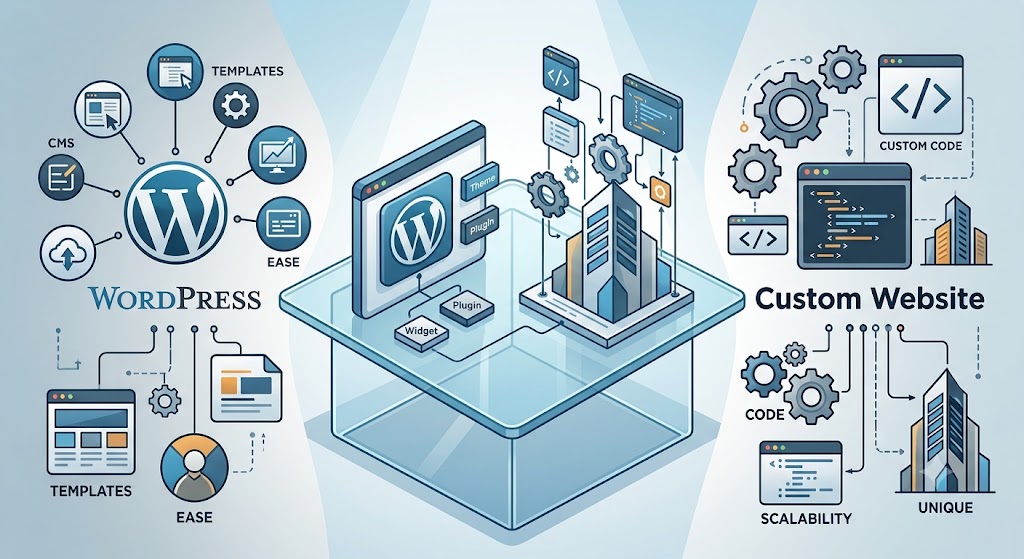
This is perhaps the most important takeaway from the comparison.
A business owner should not begin a project by saying:
"I need a WordPress website."
or:
"I want the website developed in Next.js."
Start instead with questions such as:
Technology selection becomes much easier once these answers are clear.
Imagine an Ahmedabad-based professional service company requiring Home, About, individual service pages, case studies, blogs, contact forms and lead tracking.
A properly developed WordPress website may be entirely appropriate because the core requirement is content management and lead generation.
Now imagine a company requiring customer login, custom dashboards, live operational data, multiple permission levels, workflow automation and integrations with internal software.
That requirement should be evaluated as an application rather than automatically trying to assemble the entire system through CMS plugins.
A conventional product business may work very well with WooCommerce.
But an e-commerce business with highly specialized product configuration, complex B2B pricing or unusual fulfilment workflows may require significant customization or a different architecture.
Yes. WordPress can be very effective for business, service, content and lead-generation websites when it is properly designed, developed and maintained.
Not automatically. Custom development provides greater architectural flexibility, but WordPress may be more efficient for requirements already well served by a CMS. The better choice depends on the business requirement.
Yes. WooCommerce turns WordPress into a capable e-commerce platform and can support substantial customization. Platform selection should still consider catalog complexity, integrations and operational requirements.
WordPress provides a strong foundation for managing SEO elements, but rankings depend on content, technical implementation, site structure, performance and authority rather than the CMS alone.
Yes, but migration needs planning. Content, URLs, SEO metadata, images, customer information and integrations may need to be migrated depending on the project.
For many conventional small-business websites, WordPress can provide an efficient balance of cost, functionality and content management. Businesses requiring application-specific functionality should evaluate custom development rather than forcing complex requirements into a conventional CMS setup.
The WordPress vs custom website decision should not be treated as a competition between technologies.
WordPress is highly effective when your requirements align with what a mature CMS can provide. Custom development becomes valuable when your business needs specialized functionality, workflows or architecture.
The best development approach is the one that solves your business problem without introducing unnecessary complexity today or creating avoidable limitations tomorrow.
Share this article:


UI/UX Designer, Full-Stack Developer and Digital Experience Consultant with over 10 years of professional experience in helping businesses succeed online.
A practical 2026 pricing guide for businesses

A practical guide to finding the right development partner for your business

Compare cost, control, customization and maintenance before choosing your e-commerce platform
— LET'S BUILD SOMETHING
Let's discuss your business goals, content, functionality, integrations and future plans before deciding which technology makes the most sense.
